Your Art and the Alchemist's Desert
You drown not by falling into a river, but by staying submerged in it. - Paul Coelho

What if the most stagnant, soul-crushing moments of your creative life are actually a gateway to the most productive? This is the startling premise hidden within Paulo Coelho’s The Alchemist, a deeply metaphorical fable following a young Andalusian shepherd named Santiago who abandons his flock to seek a buried treasure near the Egyptian pyramids. While the world often reads this as a simple story of following one's destiny, for the artist, it is a profound map of the creative psyche, specifically and especially the “Desert" phase of a project. There is myth that great artists produce great art nonstop, but the reality is that greatness emerges from the agony of a creative block. More precisely, it resides in the realization that the alchemy of your work only happens when the initial excitement evaporates, leaving you alone with the silence. Throughout Santiago’s trek across the Sahara, Coelho shows us that the desert isn't an obstacle to the treasure; it is the laboratory where the artist is finally stripped of ego and taught to speak the "Language of the World" that will enable him to find it.
It's the possibility of having a dream come true that makes life interesting
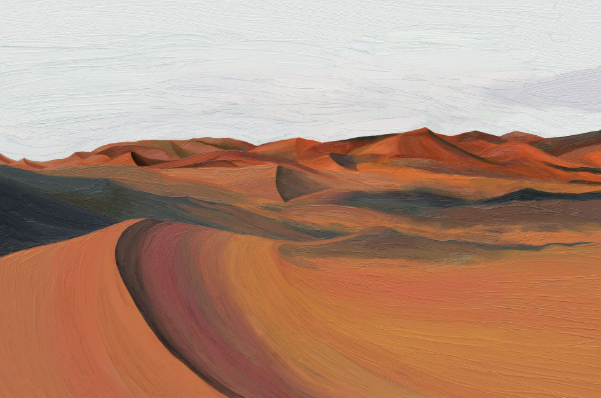
In the early stages of a creative project, we are fueled by the Beginner’s Luck described by Coelho as a rush of easy ideas and effortless momentum. But eventually, every creator finds themselves in the Alchemist’s desert: a vast, featureless expanse where the initial adrenaline vanishes and the universe falls silent. To the frustrated artist, this silence feels like a void or a failure of talent, yet in the logic of alchemy, this sensory deprivation is a mandatory stage of transformation. Just as the desert forces Santiago to stop relying on his eyes and start listening to the beating of his own heart, a creative block strips away the noise of external validation and easy tropes. It is only in this vacuum of nothingness that the artist is forced to develop a more profound intuition, moving past the superficial layers of their craft to reach a level of work that is genuinely elemental.
When the grand vision of a work is obscured by the dunes of a creative block, the artist must pivot from crushing themself in search of only the end result, to finding the hidden omens scattered about in their life. In the Sahara, Santiago learns that survival depends on his ability to read the subtle shifts in the landscape, such as the flight pattern of a hawk or the specific texture of the sand, rather than staring at the distant, unmoving horizon. For the musician or writer, this means abandoning the search for a finished symphony or a completed novel and instead hunting for microscopic moments of revelation. These omens are the tiny, overlooked details: a single sentence in a notebook, an unexplained urge to change a note, or an accidental brush stroke. Alchemy is rarely a sudden explosion; it is the quiet, disciplined practice of accumulating these small, honest observations until they allow you to hear the most critical whisper of all: the beating of one’s own heart. By honoring these minor omens, the creator learns that the desert isn't a contentless silence – it is the teacher that lets you to see what is hidden beneath the world’s noise.
Listen to your heart. It knows all things, because it came from the Soul of the World, and it will one day return there.
The true alchemy of the desert occurs when Santiago is challenged to perform the impossible: to transform himself into the wind or perish. In this climactic scene, the hero is captured by a hostile tribe who threatens to kill him if he cannot perform a miracle. He realizes that he cannot rely on his past identity as a shepherd to survive and is forced to stand atop a cliff and speak to the desert, the wind, and the sun. This isn't a feat of willpower, but of total surrender to the lessons he has spent the journey learning to hear. For the artist, this is the moment the creative block finally breaks – not because the external circumstances changed, but because the artist did. The revelation is the realization that the drought was never a lack of talent; it was a stripping away of the ego’s old, tired methods. By finally letting go of how the work should look and embracing the raw, elemental truth of what it is, the creator finds a sudden, violent surge of power. Like Santiago’s whirlwind, the breakthrough arrives as a force of nature that feels both alien and deeply personal, proving that the most profound art is not something we invent, but something we finally become empty enough to contain.
There is only one way to learn... It's through action. Everything you need to know you have learned through your journey
Santiago eventually reaches the pyramids and discovers one of my favorite twists in any book: that the treasure he sought was buried back at the very church where his journey began, yet he could only possess the wisdom to find it by enduring the trials of the Sahara. For the artist, this is the final, humbling lesson of The Alchemist: the treasure of a completed work is never just the object itself, but the person you became while trying to create it. Your creative block is not a detour or a sign of failure; it is the necessary forge where your vision is tempered, and your ego is burned away. The next time you find yourself staring at a silent canvas or a static screen, do not fear the heat or the emptiness. Trust the desert, listen for the omens, and keep walking. The alchemy isn't just in the gold you produce; it’s in the courage it takes to cross the sand.