The Aesthetics of Wealth Inequality

Sometimes richness looks like an opulent mansion, sometimes it looks like a sleek modern home. In these different aesthetic visions of wealth, we get different accounts of its injustices.
The Aesthetics of Wealth Inequality
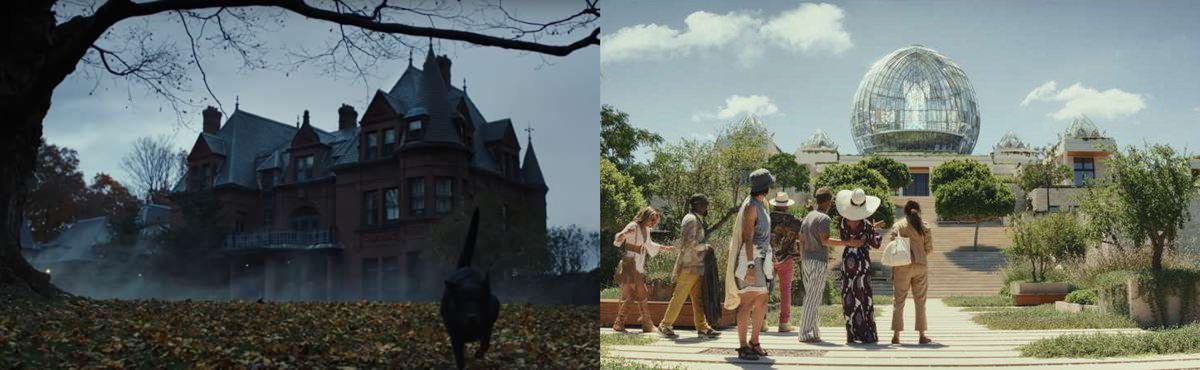
The central locations in Knives Out (2019, left) and Glass Onion (2022, right) present very different visual styles of wealth.

There’s much that is textually similar about the first two of Rian Johnson and Daniel Craig’s Benoit Blanc mysteries: Knives Out and Glass Onion. Both films satirize rich people, where in contrast to the typical whodunnit trope of having ambitious underlings be the murderers, guilt ends up squarely on the richest, most privileged characters. The central murders in each film are both explicitly characterized as an attempt by the wealthy to keep total control over their oligarchic power. Yet for two films both about the injustice of wealth inequality, the visual styles they use to depict that wealth could not be more different.

Knives Out is a notoriously cozy film set in an old-timey New England mansion; Glass Onion is on a billionaire’s extravagant private island in the Mediterranean. Knives Out’s aesthetics are a classical Victorian; Glass Onion’s are distinctly modernist.

The divide between these depictions of wealth extends well beyond the world of Benoit Blanc. Recent films and series have given us strong representation of wealth on both sides. In the classical vain, there are Knives Out, The Brutalist, The Phoenician Scheme, a handful of Atlanta episodes (but most notably “Teddy Perkins”), and most versions of the Dracula/Nosferatu story, including last year’s directed by Robert Eggers. But plenty of works focused on wealth inequality use modernism for their wealth aesthetics: beyond Glass Onion, there are Parasite, The Curse, Severance, and Bugonia. Through these two broad camps of wealth aesthetics, we get two different conceptions of the injustices of wealth inequality. The classical styles come to represent an overbearing, historically institutionalized form of oppression, whereas the modernist styles reflect a more insidious form of oppression, based around the invisible barriers of hyper-capitalism.

(A note, by the way, for the architecture people who are undoubtedly mad at me: I’m using “classical” as a blanket term to describe the various pre-20th century styles these works use. It’s just more expedient for my purposes here than to distinguish between Victorian/Baroque/Gothic. Yes, I’m aware that none of these styles fall under actual architectural classicism, meaning Greek and Roman architecture of antiquity. If you feel the urge to write me about all the distinctions I’m skipping over, please feel free.)

To get a better sense of the different conceptions of wealth at play here, let’s return to the Benoit Blanc whodunnits. Our main set of characters in Knives Out is the Thrombey family, whose several generations grew up rich. The source of conflict throughout the film is the massive inheritance of its late patriarch Harlan, with the conflict really escalating when he leaves his entire estate not to any of his children but to his nurse Marta. The Thrombey family is the total embodiment of rich white privilege. They might occasionally voice progressive viewpoints and insist that Marta is family, but their actions demonstrate that they don’t care about her at all, and they take every opportunity to make her a thing, neither seen nor heard, only there to serve their interests. Despite their rhetoric inclusive of Marta, they insist she has no claim to the inheritance Harlan has given her, even though she is the only one to have shown any actual concern for his well-being. They feel entitled to their generational wealth despite the fact they never did anything to earn in themselves. Here, the classical Victorian architecture of the film’s setting becomes an expression of that generational privilege, the massive mansion a demonstration of the social hierarchy the Thrombeys are so keen to protect.

In Glass Onion, by contrast, our wealthy figure of interest is not from a lineage of generational wealth, but the self-made billionaire Miles Bron, a thinly veiled stand-in for Elon Musk. As the film will reveal, this self-made billionaire is not self-made in the slightest; every aspect of his success was stolen from someone else. But that is the image Bron projects. The extravagance of his island comes not from a love of extravagance itself but as a love of the wealth needed it acquire it. He rents out the Mona Lisa from the Louvre at the height of the pandemic not because he has any particular affinity for the painting, but because he likes that he has the money and power to do so. The painting, like the rest of the estate, like his entire livelihood, is not a work of art, not something with value in itself, but something only valuable because of its monetary significance. What Bron projects aesthetically is not generational, high-class, institutional power, but buying power.

To that end, Bron is not interested in the overt displays of dominance the Thrombeys love, at least not explicitly. The image he puts forward is instead of a cool, casual guy. His fashion is laid-back. His pretense for instigating the film’s events is wanting to hang out with his friends. There is of course a massive gulf in power between him and everyone else in the film, but he would never admit that. He would insist that he’s no different from you. He lets the absurdity of his wealth do the talking for him. That wealth, reflected in the modernism of his estate, makes no outward attempts to be intimidating, to flaunt its grandeur, but it does silently draw a line between its owner and us regular people. That line is never to be acknowledged, but must always be respected.

This, then, brings us to one of the key differences in the way wealth carries itself in these different depictions. The classical version of wealth wants to assert its power at all times, to make one hyper-aware of the innate differences between those in power and those who serve it. Modernist wealth by contrast wants to hide its presence. It will implicitly preserve the power imbalance present in the wealth inequality, but in doing so it will put up the appearance of no such imbalance existing.

We can see these differences beyond the Benoit Blanc films. On the classical side, we have The Brutalist, where Harrison Van Buren’s mansion stands as an omnipresent reminder of his class advantage over László, alongside his ongoing microaggressions reinforcing that message. Here, László’s modern brutalist style actually stands as a rejection of Van Buren and his wealth. Where Van Buren’s space is defined by its opulence, László’s central project is defined by its sparseness. Its defining feature, the large cross in the chapel, is literally made of negative space. In Nosferatu, Count Orlok’s castle is a constant source of intimidation, and in both The Phoenician Scheme and “Teddy Perkins,” the main characters’ mansions form strange worlds unto themselves, highlighting their inhabitants’ total separation from anything resembling the lives regular people live.

On the modernist side, the invisible, unacknowledged but omnipresent line between the wealthy and the non-wealthy is a literal visual motif in Parasite, where shots are often framed so that an object forms a literal line between working-class characters and members of the affluent Kim family. This invisible barrier between classes may also be a big reason for the popularity of glass in these modernist sets, being as it is a literal transparent barrier. The headquarters of the Auxolith company in Bugonia are a prime example of such a design, the corporately popular open-concept office taken to the extreme. Bosses sell such a design as a way to foster equality and collaboration, when really it eliminates all privacy and effectively becomes a panopticon. Michelle Fuller, the CEO of the company played by Emma Stone, reinforces the fake-friendly oppression with her policy that workers should feel free to go home early, unless, of course, they still have work to do, in which case they should absolutely stay and finish it.

The best recent example of films using modernist aesthetics of wealth to represent predatory capitalism disguising itself as egalitarian progressivism, though, comes from another Emma Stone work: The Curse. Her character Whitney flips homes in Española, New Mexico, entirely redesigning them into absurd modernist structures that basically look like giant mirrors. She fancies herself a philanthropist and environmentalist, creating carbon passive homes that are supposed to be invisible, reflecting the beauty of the surrounding landscape. This is the image she is pushing on her HGTV show touting the project. Of course, what she is really doing is gentrifying the city, and her houses with their distorted reflections stick out as a symbol of her predatory nature. She initially wants nothing to do with her wealthy slumlord parents, but once she finds herself in financial trouble she is quick to fall on them for a loan. She wants desperately to be a progressive ally, but is unwilling to listen to any of the people she is allegedly trying to help about what that would actually mean, and is certainly not willing to relinquish her own privilege for the sake of those people.

Now there is a simpler potential explanation for the difference in visual styles between all these works: historical setting. The modernist styles are all in projects with contemporary (or, in the case of Severance, vaguely futuristic) settings, while many of the works using classical aesthetics to depict wealth are period pieces. Nosferatu is set in 19th century Germany, The Brutalist and The Phoenician Scheme in the mid-20th century. Thus, the art direction of these works may not be making intentional choices to depict wealth in a certain way so much as it is trying to replicate the dominant aesthetics of the period in which it is set.

This may be true, but two points in response. First, not all the classical styles are in historical settings – Knives Out and Atlanta are both set in present day – nor is all the architecture of contemporary wealth necessarily modernist. Parasite could have easily been set in an older extravagant mansion, and it would have been a very different film were this the case. Second, even if these works are only interested in period accuracy, dominant styles of a particular period still carry ideological baggage. Victorian and Baroque styles descend from monarchical societies where the grandeur of one’s home was an explicit status symbol, societies with little social mobility where the rich were believed to be intrinsically different kinds of people from those of the working class. Modernism arose in a 20th century where two world wars destroyed the age of empires and monarchs, where a nation’s power came from its economic influence rather than political territory, and where industrialization had made social mobility much easier. The abstraction of modern art was a means of dismantling the enforcement of social hierarchies built into previous styles. All this historical context fits perfectly with the images of wealth these styles convey. Thus, even if a film’s choice of a visual style was more historically than thematically motivated, the historical environment which gave rise to a period’s dominant style still carries thematic material that comes through in the film.

In a sense, both the classical and modernist visions of wealth are trying to sell themselves as the natural one, the classical by reinforcing a naturally ordained social order, the modernist by becoming “invisible” and refusing to put up clear social barriers. The naturalism in both cases is an illusion. Whether a caste system or a free market, there is still a system of control that prevents the less privileged from ever posing a serious threat to the elite. Whether an imposing castle or an open-concept glass office, these structures are still unnatural manipulations of their environments designed to sanctify the power of those who made them. So while our cinema may present aesthetically distanced visions of wealth that give different accounts of what the oppression from this wealth inequality consists in, these styles and the theories of inequality that comes with them are ultimately variations on the same theme.