The Absurdism of All Is Lost
The 2013 film of a man lost at sea is a potent representation of all humanity's efforts to master the world made powerless against a world that does not care.
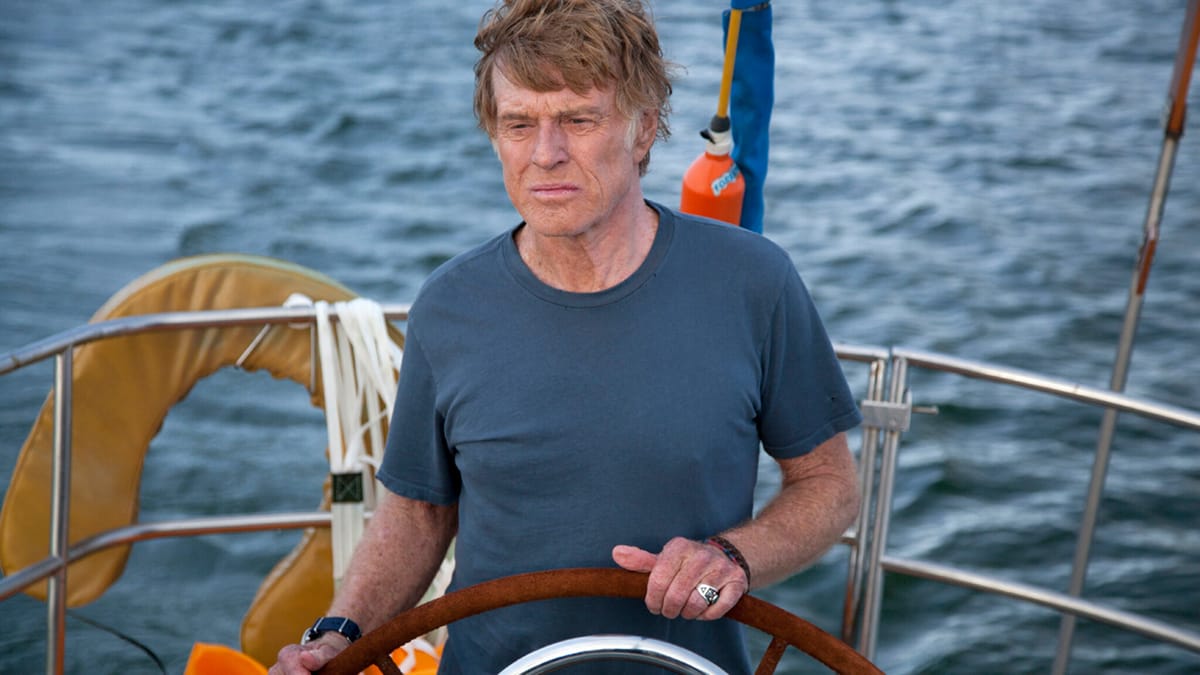
Robert Redford’s character in All Is Lost has no name. The end credits refer to him only as “Our Man.” He is given no backstory, and the film has no interest in probing his psyche. It gives him exactly one opportunity to express himself eloquently: an opening narration, constituting the vast majority of the film’s spoken words, which ends up being the text of a message in a bottle he sends off into the ocean once he has accepted his own hopelessness. But even here, he speaks in vague terms. Except for one mention of having half a day’s ration left, the regret he expresses here of a failure to be good and right could reasonably apply to anyone sufficiently worn down by life, not just someone marooned at sea.
All Is Lost is not thematically interested in specifics. Like the nondescript character we follow, like the vast, empty ocean on which it is set, the film is an abstraction. It gives an account of the most ancient, primal story there is – man against nature – in order to explore an equally deep and primal experience. Redford’s character, “Our Man,” is humanity entire, his experience the human experience. Calling a film an expression of the human experience usually amounts to lazy criticism. But with a film as sparsely constructed as All Is Lost, the label may be appropriate. We find in this film a perfect representation of the Absurd, of all the efforts and plans of mankind made moot against the uncaring forces of nature.
To say that Redford’s character here lacks development in terms of backstory or complex psyche is not to say that he lacks characterization. On the contrary, we learn a great deal about him as we watch him try to manage the crisis precipitated by a stray shipping container puncturing his boat’s hull in the film’s opening moments. We learn that he is resourceful and focused, that he is quick to form a plan of action and remains composed under pressure. But more than anything else, what we learn about Our Man as we watch him battle to save first his boat and then his life is that he is determined. He gives every measure of effort he can towards surviving, both the physical effort of piloting and hanging onto his boat through a massive storm, no small feat for a man of his age (Redford was in his mid-70s when the film was shot), and the mental, emotional effort of maintaining a level head as everything falls apart around him. When things go wrong, he executes sound plans, and when those plans go wrong, he makes new ones. In the opening narration, Our Man at least hangs his hat on the fact that he tried, that he fought till the end. On this point no viewer can deny him.
All Is Lost is built around a cruel irony: Redford’s character does everything right, everything bad that happens to him is a total fluke, and yet he loses anyway. Our Man is as competent a solo sailor as one can find. His boat is well-prepared with all the necessary equipment to deal with a crisis like this. He demonstrates nautical skill piloting a boat through a storm, and even when forced to abandon ship, he learns astral navigation on the fly, and even improvises a means of distilling fresh water on his life raft. He gets himself into two major shipping lanes, putting himself in as good a position as possible to get himself rescued.
But all of Our Man’s competence is no match for the barrage of bad luck that comes his way. The initial crisis that strikes him is a total freak accident; of all the places a stray shipping container could have ended up in the entire Indian Ocean, it just happened to crash into his boat. Then a massive tropical storm strong enough to break his mast comes before he has an opportunity to fix his radio. Even when Our Man is inches away from being saved, when on two occasions a massive container ship that could be his savior passes by, the ship does not spot him. Redford’s character has done everything he possibly can to survive, but nature does not care how prepared you are, how much effort you put in, how long you refuse to give up, how much you deserve to live. If luck does not swing in your favor, there is nothing you can do to change that.
What Redford’s character is experiencing in this film, with all his competence and courage powerless against nature’s indifferent whims, is the philosophical concept of the Absurd. The idea was popularized by Albert Camus, present in most of his works and articulated explicitly in his famous essay The Myth of Sisyphus. The Absurd here refers to the dysfunctional relationship humans have with the world we live in. We have a fundamental desire for order and meaning in our lives. We want our existence to have significance; we want the world to make sense. But the universe cannot fulfill these desires. It cannot instill a cosmic meaning into our lives. It cannot order itself in a way that will satisfy us. And when we scream out against this indifference, it cannot hear our pleas.
All Is Lost makes this existential phenomenon quite literal. The Absurd usually arises in the abstract, as a means of describing the futility of people’s various attempts to wrangle meaning out of a world that will not give it to them, whether through a search for philosophical answers or commitment to some religious or moral code or the pursuit of transcendent art. We cannot spot the Absurd directly in the world’s indifference to all these pursuits of meaning, because this indifference inherently requires the world to be silent, to refuse to offer any response to humanity’s demands of it. But in All Is Lost, with its sparse concept that makes its scenario a broad metaphor, every action Redford’s character takes – patching a hole, raising his sails, lighting a flare – is a literal attempt to quell nature’s storm, and if not to master it, then to at least make enough sense of it to find his way through. And every obstacle and setback that gets thrown his way – every gust of wind and jet of water, the shark that eats the fish he catches and the ships that pass him by – is the uncaring universe actively refusing to abide. The film translates into directly intelligible action a situation ordinarily defined by silence.
There are multiple ways to construe Redford’s character against the frame of the Absurd. It would make sense to view him as a model of virtue against the blankness of the universe in light of the dedication and courage he displays against the slings and arrows of outrageous fortune. In a losing battle, he keeps fighting to the very end. He pushes the boulder as long as he possibly can. Yet Our Man here is not quite Camus’ Absurd hero, for he never seems to fully grasp the Absurdism of his situation. It is critical in Camus’ interpretation of the Sisyphus myth that Sisyphus knows there is no chance of him ever getting the boulder to stay at the top of the mountain, that it will always roll back down no matter what he does. It is this awareness of the Absurd that makes Sisyphus’ choice to keep pushing the boulder meaningful, that makes him the master of his fate, as Camus put it. But Our Man in All Is Lost does not appear to have this same awareness. All the actions he takes to resist nature seem to come from a genuine belief that he has a chance of being rescued, that he can get the boulder to the top of the mountain. And when at the film’s very end he does seem to accept the Absurd, he finally gives up and lets himself drown.
I should take a moment here to comment on the film’s ending, since I do not think it should be taken literally. It is not really the case that Redford’s character was rescued at the very last moment by some unseen figure. This ending makes much more sense as a final vision from Redford’s character in the moments before he dies. The visuals of the scene, the ascent up to a light and the final fade to white, are suggestive of going to heaven. Our Man has been worn down and broken by nature’s apathy, and so in his final moments conjures for himself an image of cosmic justice, something to comfort him and make him feel as though his efforts were worth something as he fades into the deep.
This is not at all consistent with how Camus envisions virtuous response to the Absurd. In fact, it is a reaction Camus explicitly attacks, a retreat into religious fiction that, instead of reckoning with the world’s lack of meaning, replaces it with a false world that is more palatable. Camus would have us embrace the Absurd, live our lives in spite of the fact that they carry no greater meaning, and instead create that meaning for ourselves. This Our Man does not do. In his final letter read in the film’s opening, having at last come to accept his allotted fate, he takes on a tone of defeat and apology. His regret here is not that he made a mistake in his survival tactics or failed to do something that could have saved him – he still hangs his hat on the fact that he did everything he could – but that he failed to somehow alter the conditions of the universe that cast him off to die. He, like everyone else, could not overcome the Absurd, and in his view, this makes him a failure.
While this is not what Camus nor most other existentialists would call the optimal response to the Absurd, it is a very human response. Sisyphus, even in Camus’ interpretation, is a mythical figure. He represents a psychological ideal in response to the Absurd, one which we cannot fully expect out of a regular human being with all the desires and feelings and foibles that come with existing in the real world. If Redford’s character in his underdevelopment is all of humanity, then he is not humanity in an idealized form but humanity as we really are: flawed, vulnerable, but equipped with a remarkable will to go on being. Maybe what we see from him in the film is the best we can realistically hope for. We may not be able to fully escape the grip of the Absurd, escape our need to make the world make sense to us, and we may retreat into comforting illusions when the meaninglessness becomes too much to bear. We may never become, like Sisyphus, master of our fates, stronger than our rocks. But we can face the Absurd with courage and go on fighting to the end. For as the Goethe poem that gives the film its title implies, when courage remains, not all is lost. One must imagine Redford happy.