Myth or Fact: Only True Love Can Travel to Hell and Back
How the Broadway Musical "Hadestown" Reminded Me of Christ's Divine Power

“I take thee to have and to hold from this day forth, for better, for worse, for richer, for poorer, in sickness and in health, to love and to cherish, until death do us part.”
2026 is the year for nerds obsessed with ancient Greek mythology.
I, for one, couldn’t be happier about it.
With the announcement of “EPIC: the Musical” becoming an animated feature, the third season of Percy Jackson releasing this fall, and most notably the cultural phenomenon that was Nolan’s “The Odyssey,” lovers of Greek mythology just seem to keep winning.
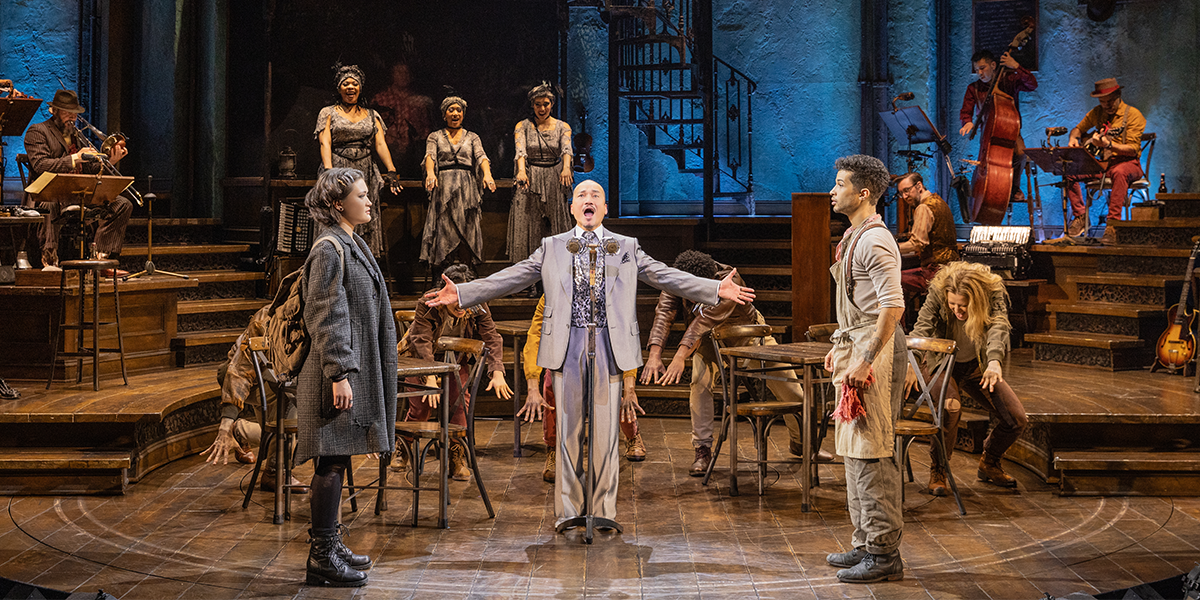
However, one more mythological retelling has been surpassing records and has already made history as the highest grossing live capture of any Broadway show.
That title belongs to Anaïs Mitchell’s hit musical: “Hadestown.”
“Hadestown” is a reimagining of the story of Orpheus and Eurydice and although the Broadway musical is one of the most unique renditions of the myth I’ve seen, it is not the first time the two ill-fated lovers have had their story adapted within recent years. Some of the most iconic retellings of the 20th century are Cocteau’s “Le Sang d’un Poète” (the Blood of a Poet), Camus’ “Orfeu Negro” (Black Orpheus), and J.R.R. Tolkien’s “Sir Orfeo.”
In case you are unfamiliar with this story, the Greek tragedy follows Orpheus, a musician born of a Muse and the god, Apollo, and a nymph named Eurydice.
When they meet, the two fall in love and quickly wed. However, they do not have the luxury of growing old together. As the myth goes, soon after their wedding day, Eurydice gets bitten by a snake and perishes from its poison. Upon hearing the news of his bride’s demise, Orpheus refuses to live in a world without Eurydice and immediately conjures a plan to journey to the underworld to make Hades return his bride to him.
With nothing but his own two legs and his lyre, Orpheus journeyed the road to hell.
As he walked to the underworld, Orpheus played music and the melodies he played were so beautiful that stones wept, breaking apart the earth for him. His songs charmed the ferryman, Charon, soothed Cerberus, and eventually, when Orpheus came before Hades, the god of the underworld was touched by the music as well.
When Orpheus made his plea, Hades allowed Orpheus to return back to Earth with Eurydice under one condition: Orpheus must lead the way, Eurydice must remain behind, and Orpheus cannot turn around to see if she’s following.
This time, the journey proved more treacherous. Plagued with anxiety, Orpheus never knew for certain if Eurydice was close behind him. When they were near the end and daylight broke through the dark, Orpheus turned around only to watch as his true love was dragged back to the underworld.
Death, though Orpheus tried to defy it, would now forever keep his beloved from his embrace.
It is said he spent the rest of his days composing songs of grief.
“It’s an old song, it’s a sad song, it’s a love song,” goes a refrain from the hit jazz musical.
Over the years, “Hadestown” has easily found a loyal fanbase since its release in 2010 and then again on Broadway in 2019. Yet, there has been a point of contention among the faithful viewers, one that always results in fierce debate: “Why would Orpheus turn around?”
Many cannot wrap their head around the fact that Orpheus would turn around despite explicitly being told not to. However, a common phrase I’ve seen these past couple of months is: “an Orpheus that doesn’t turn around is an Orpheus who never loved Eurydice.” Some agree with this while others adamantly disagree, specifying that Orpheus turned because he wasn’t convinced of Eurydice’s love for him. His doubt caused her descent back to hell.
No matter which side of the coin one falls on, as “Hadestown” continues to grow in popularity, I cannot help but relish in hearing all the different interpretations people have. Because at the end of the day, this ancient tale is fundamentally a great example of what it means to be human.
If we’re scared, we instinctively turn and search for the ones we love.
After performing on stage, we search the crowd for our friends and family.
When we have a long day at work, we pick up our phones and can’t wait to hear our loved one's voice on the other side.
It’s second nature.
Whether in a song, movie, a book, or even in real life, have you ever heard a person say to another: “You are my other half”?
In case you were not aware, that saying is a concept coined by the ancient Greeks. They believed that humans were first created with two heads, fours arms and four legs.
In fear that humanity would grow too powerful in their ‘original’ form, it was said that the god Zeus cut people in half and ordered Apollo to refashion them into the forms we have today. But when this happened, humanity was devastated from the brutal division:
“Now, when their nature was divided in two, each half in longing rushed to the other half of itself and they threw their arms around each and intertwined them, desiring to grow together into one, dying of hunger and inactivity too because they were unwilling to do anything apart from one another.”
To this, the Athenian playwright, Aristophanes, continues his speech in Plato’s Symposium and stated that “each [person] then is but the token of a human being, sliced like a flatfish, two from one; each then ever seeks his matching token.”
Now, I do not believe that there’s another human being out there who will complete me.
I am not a puzzle piece. I am not a ‘half’ in desperate need of finding my other half.
But, in this one aspect, the ancient Greeks and I are in agreement:
To be human means searching for the one you love.

As an avid fan, I was beyond excited to watch the “Hadestown” pro-shot in theatres and even forced my brother to come with me. To say I was blown away by the set design, the performance of each actor, and the film’s cinematography would be a massive understatement. I was left speechless the entire way through and by the end of it, there was nary a dry eye left in that theatre (consider this as a warning to bring tissues).
But, unexpectedly, when the credits rolled, I could only think of one thing:
Jesus is the only man who successfully rescued His Bride from the depths of Hell.
As it says in Ecclesiastes 3:11, eternity is written on the heart of man. Whether one has faith in Jesus or not, I truly believe that every person longs for a love that cannot be satisfied by another here on Earth.
Unknowingly, Mitchell’s “Hadestown” is proof that – if ever we found ourselves in the same shoes as Eurydice – we all desire a great love. A love that would set them on journey to Hell to bring us back to the land of the living.
We would want our partner to defy the devil himself.
We would want our lover to bring us back home.
We would want our spouse to do whatever it took to be reunited as one in matrimony again.
That is exactly what Jesus did when He came to earth.
Jesus came to rescue us from darkness and to give us eternal life (John 3:16-21).
Jesus defied Satan himself (Revelation 1:17-18).
Jesus gave us access to the Father and enabled us to be seated with Him in heavenly places (Ephesians 2:1-8; Hebrews 10:19-25).
Jesus obeyed God so that humanity could be made one with Him again (John 17; 2 Peter 3:9).
Like the Good Shepherd He is, it’s in God’s nature to search for the lost because He is abundant in grace, lovingkindness, and mercy. God is incapable of acting unlike Himself; therefore, we can always have confidence that when we wander off, He will do everything in His power to go after us (Luke 11:32).
As I continue revisiting this musical, I end up growing all the more convinced that the human heart is forever crying out to find a perfect, unfailing love.
I think one of the greatest traps we can fall prey to nowadays is the notion that we can only find fulfillment in another person, be it a friend, family member, or partner. Though I am firm advocate for community and I do believe that we were made for connection, I also believe that our souls can only find true satisfaction in the God that created it.
In God, we belong.
Because of His enduring love, we can live forevermore.
More than that, because of Jesus, death and Hades is still robbed of the power they once had.
Jesus' passion for His people is the greatest and most powerful love story this world will ever know.