Mary the Lifeguard: Nick Leeper, S.J, on Finding God in Ordinary Things
We should judge religious art by whether it reveals God to the viewer.

Nick Leeper, a Jesuit artist, paints the Virgin Mary on lifeguard duty and saints in the language of advertising. He told the Art Newsletter why the sacred belongs in the ordinary, and why Christian art should do more than preach.
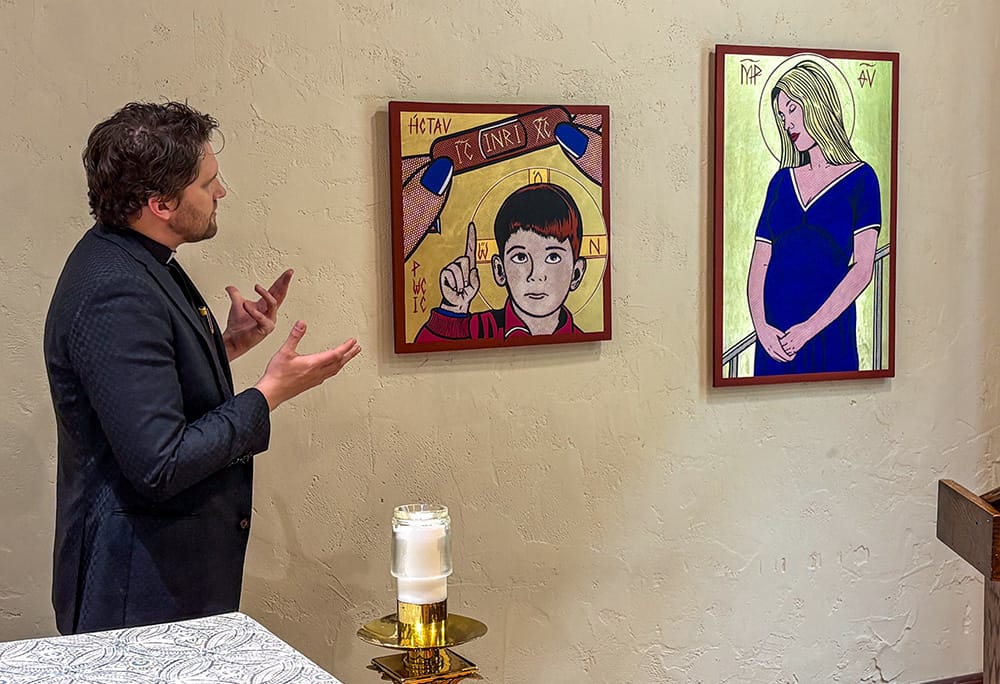
His latest piece, Our Lady Help of Christians, shows the Virgin Mary as a lifeguard, with Christ cast as the tanning lotion. It has sparked debate about how the body belongs in religious art. For Nick, it is an old Jesuit idea put into paint: that God can be found in all things.
We spoke about a silent retreat that changed his life, the trouble with Christian art that only preaches, and his upcoming show at Fordham.
What follows is our conversation, lightly edited for clarity.
Mareez: How did your journey into art begin?
Nick: In college, art was really just a hobby for me. That changed after I joined the Jesuits. In 2019 I was on a 30-day silent retreat, and I came across an art book by Sister Wendy Beckett. It opened something up. I started to see art as a powerful spiritual tool, a way of imagining biblical stories and reinterpreting them. I went on to study the theology and philosophy of art at St. Louis University.
Mareez: How does Jesuit spirituality shape the way you work?
Nick: At the heart of it is the idea of finding God in all things. If that's true, then religious stories can be told in everyday, ordinary settings. That's what I try to do.
Mary on The Lifeguard's Chair
Mareez: Tell me about Our Lady Help of Christians.
Nick: It shows Mary as a lifeguard, the one who keeps watch and helps people in danger. Christ is in there metaphorically as the tanning lotion, the thing that protects you. The swimsuit was meant to be modest by American standards.
Mareez: It's drawn a strong reaction. How do people respond to your work?
Nick: People who come to the exhibitions in person generally understand it and appreciate it, even if some of them disagree. Online is harder. People are anonymous behind a screen, and a lot of the critics there don't want to engage.
Did Mary have a body?
Mareez: Why do you think the swimsuit unsettles people so much?
Nick: I think it comes down to a question: did Mary have a body, and was her body holy? A lot of people associate bodiliness with sinfulness. That's something we've inherited through tradition.
Mareez: I agree. You see it in how Mary's motherhood is usually painted. The images almost never show birth realistically.
Nick: Part of it goes back to ancient Rome. Veiling started as a practical measure. Over time it was spiritualised, and eventually it became a religious tradition. Those customs still shape how we feel about the body today.
Beyond Piety and Propaganda
Mareez: What do you think has held contemporary Christian art back?
Nick: The church has often cared more about the artist's piety than their ability. Look at Caravaggio. His personal flaws don't diminish his art at all. A lot of modern Christian art either becomes propaganda or settles for realistic depiction, without really communicating the Christian message.
Mareez: So how should we judge religious art?
Nick: By whether it reveals God to the viewer. That matters more than the artist's religious background.
Mareez: Are there approaches you find more effective than others?
Nick: Kelly Latimore depicts things quite directly. Byzantine iconography is different. It invites deeper engagement and leaves room for your imagination. That's closer to what I'm after.
Research, Prayer, Paint
Mareez: Walk me through your process.
Nick: I start by researching a theme. Then I pray with it. After that I look for the connection to something contemporary, like advertising. I want people to think deeply about how God is revealed in ordinary things.
Mareez: How long does an icon take?
Nick: About a week to paint. Before that, there are about three days preparing the wooden panel, putting on layer after layer of gesso.
Afterword
Nick's work asks something simple and difficult of its viewers: to look for God where they least expect to find him. That approach will not please everyone, and Nick does not expect it to. What he hopes for is engagement, the kind that happens face to face, in front of the work, rather than behind a screen. Whether the work provokes or consoles, the aim is the same: art that reveals rather than preaches. Nick's upcoming show at Fordham opens in November. Proceeds from his original icons and prints support the Jesuits and their charitable missions.