Every Novel Comes from the Same Joke
The most difficult character in comedy is that of the fool, and he must be no simpleton that plays that part.

I get a particular kind of dread when picking up famous books, because there’s always pressure to pretend that I like them even if they suck. Initially, I expected Miguel de Cervantes’ Don Quixote to give me that feeling. After all, it’s the first novel ever written, a cornerstone of Western literature, the whole apparatus of canonical gravity, and so it's genuinely disarming to discover that it's actually hilarious. Miguel de Cervantes is funny in a way that feels alive and contemporary, and the book has more to say about obsession, delusion, and the stories we tell ourselves than most novels written last year. However, Don Quixote is an especially special book, where the story of how it exists is as compelling as the story itself. The biography of the book, its author’s incredible resilience, and the bizarre circumstances of its completion reframe everything inside it. So, consider this a detour from my usual writing to explore how the story behind this story really makes this 400-year-old modern novel interesting. It all starts, as the best stories do, with a man whose life has gone almost completely wrong.
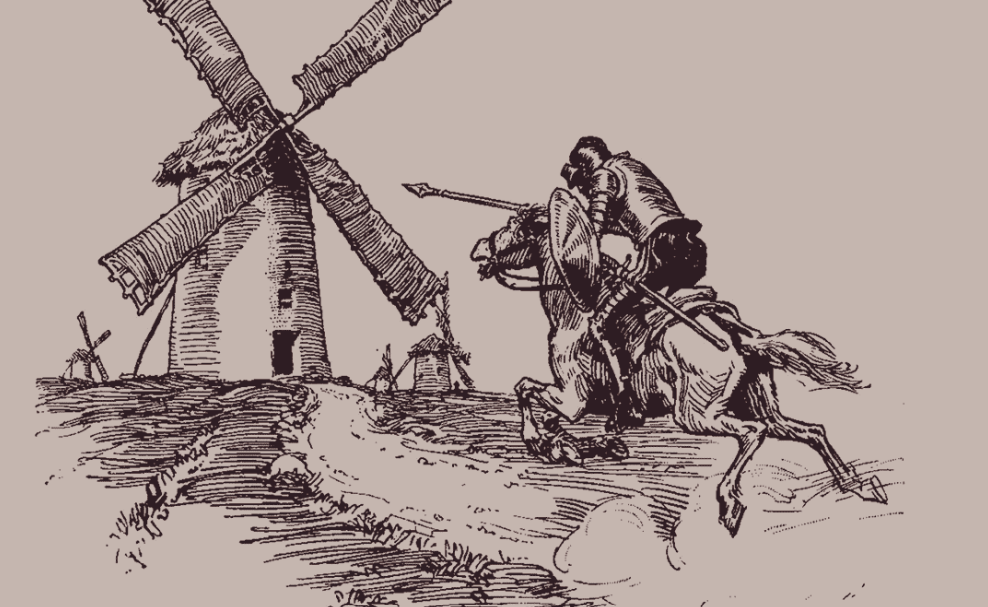
"Now look, your grace," said Sancho, "what you see over there aren't giants, but windmills, and what seems to be arms are just their sails, that go around in the wind and turn the millstone." "Obviously," replied Don Quixote, "you don't know much about adventures."
Most of Miguel de Cervantes ' life was a series of unfortunate situations. He was born with a stutter in 1547 in Spain. His father was frequently in debt and constantly on the move until he was arrested because he couldn’t pay what he owed, leaving Cervantes and his six siblings to be raised by his mother, who managed to support her family on her own until his release. As a young man, Cervantes managed to attend a university until his father once again fell into debt and they were forced to move. A few years later, Cervantes had a warrant for his arrest for wounding another man in a duel. He fled from Madrid to Rome and joined the Holy League to fight the Ottomans, hoping to have his warrant rescinded. But his luck did not improve. In 1571, at the Battle of Lepanto (one of the largest naval battles in history), Cervantes received two gunshot wounds to the chest and one to the left hand, which he lost the use of permanently. On his way home, his ship was captured by Ottoman pirates, and he spent the next five years as a slave in Algiers before his family scraped together enough for a ransom. He returned to Spain expecting recognition for his military service and received almost none. He tried writing plays. None took off. He became a tax collector, which seems like a grim enough fate on its own, but he was also briefly excommunicated and imprisoned at least twice over accounting disputes. At last, he was in his late fifties, largely obscure with nothing to lose, and he published the first part of Don Quixote. There is something almost perverse about the gap between this biography and the monument it produced. Cervantes wasn't a well-renowned literary genius; he was a one-handed, stuttering, poor man, writing from the outside, with nothing going for him. Yet it was in that state he produced one of the most influential works of literature in history.
"When life itself seems lunatic, who knows where madness lies? Perhaps to be too practical is madness. To surrender dreams — this may be madness. To seek treasure where there is only trash. Too much sanity may be madness — and maddest of all: to see life as it is, and not as it should be."
Knowing what Cervantes was actually trying to do (which was not, by any measure, revolutionize literature) makes the impact of his creation so much wilder. Having had brutal experiences in the real world, he wanted to mock chivalric romances, the dominant popular fiction in his lifetime. These stories were about idealized knights performing impossible feats in mythologized worlds, written in a grandiose style that Cervantes thought was utterly ridiculous. He set out to write a short comedic piece that would point out the absurdity of the genre, using a protagonist so consumed by these romances that he loses his grip on reality entirely. It was just a joke with a specific target, but somewhere in the writing, the joke outgrew itself. The main character, Don Quixote, was created to be a figure of ridicule, but ended up an emotionally complex character that developed over time. This was an innovation in an era where characters were supposed to be static; villains were always villainous, heroes always heroic, and fools always foolish. The story certainly began as ridiculous nonsense, but as it unfolded, both Don Quixote and his sidekick Sancho Panza experienced organic growth that genuinely made me feel things for them. That shift, from object of satire to subject of genuine feeling, is where the idea of the novel was born. Before Quixote, fiction's characters were largely unchanging vessels for moral allegories. But Cervantes, almost by accident, wrote something resembling a person. A confused, contradictory, deeply human person.
"The most difficult character in comedy is that of the fool, and he must be no simpleton that plays that part."
But Cervantes’ writing did more than change the way characters were written. Prior to Don Quixote, fiction largely lived in something called mythologized elsewhere. It took place in Arthurian England, ancient Troy, or enchanted kingdoms, for example. The physical world of a story was a made-up backdrop that was ornamental and vague, because the point was not telling a realistic story. Cervantes, though, did something that sounds normal today but was radical at the time: he set his story in contemporary Spain. He used real roads, inns, social classes, and politics so that Quixote rode through a world his original readers, even if uneducated, would recognize. Paired with this was something equally new in the style of narration. Cervantes wrote with a layered irony toward his protagonist so that readers didn’t get a clean reading. Instead of writing in an obvious moral to the story like other authors of the time, you can never quite settle on whether Quixote is pitiable, admirable, or simply mad, because the narrative voice doesn’t just hand that to you. Ambiguity was not a feature of fiction at the time. Stories told you how to feel. But Don Quixote leaves you in genuine uncertainty, which is where real life tends to leave you, too. The recognizable world and moral ambiguity are what scholars are really pointing at when they call this the first modern novel. What was intended to be comedy was a new relationship between fiction and reality.
"For land that's dry and unfruitful will give you good crops, if you put on enough manure... I mean, your grace's words have been like manure spread on the barren ground of my dry and uncultivated mind."
After his first novel’s publication in 1605 became a sensation across Europe, Cervantes did something else that was humorous and new. At this point, he was finally undeniably famous. Delighted at the novel’s success, he began to write Part II of the story, but fame without the modern protections of intellectual property was a fragile thing. In 1614, while Cervantes was still writing, another writer publishing under the pseudonym Alonso Fernández de Avellaneda released his own sequel. It was mean-spirited, widely considered inferior, and it depicted Quixote and Sancho in ways that Cervantes found insulting to his own characters. He was furious. In response, Cervantes did something that made the story even more innovative; he broke the fourth wall. In his real Part II, published in 1615, Cervantes makes Quixote and Sancho encounter characters who have read the fake version. They express their contempt for it, ridiculing it as wildly inaccurate and sloppily put together from inside the fiction itself. Cervantes essentially blurred the line between the world of the story and the world in which it was written so completely that the two became inseparable. For a book that was already renowned for its convolution of fiction with reality, it was a perfect, petty, final statement.
"'As Sancho says, silence is golden.' 'That must be some other Sancho,' said Don Quixote."
The first novel ever written came from a man who spent most of his life losing, sat down to write a joke, and ended up creating something that accidentally contained all of it: the mundane world, the unreliable self, the story that knows it's a story. None of that was planned, and that's what made it possible. Cervantes had no reputation left to protect and no future to safeguard. He had been a soldier, a slave, a debtor, and a criminal, and had a stutter and only one functional hand. By his late fifties, the world had already done its worst. His misfortune freed him to do something serious writers couldn't: write without the weight of consequence, without the self-consciousness that comes from having something to lose. Revolutionary art always seems to come from that place. No one can force it to happen; it comes in the desert, by accident, from the soul. Cervantes died in 1616, the same year as Shakespeare, without the wealth his fame deserved, never knowing the monument he'd left behind, but the serious impact of his unserious work can be thanked for every novel you read.